

This is probably the most asked question we get about living on the boat. What do you do with your boat when you go somewhere? What do you do with your boat at night? Unlike living on land, our location and needs change almost daily, so what we do with the boat varies.
If we are going away for a long time, putting the boat on a dock is a good option. It is the most expensive option, because we need to rent the dock space, but it provides the most stable support for our boat while we leave. There is usually security patrolling, and sometimes cameras we can check. Docks also have access to WIFI, water, and electricity. For us, that’s not as important because we have a water maker, solar panels, and satellite internet via our Starlink.

The cons of staying on a dock are numerous. Aside from being cost prohibitive, it’s actually easier for strangers to walk onto our boat. It also increases the likelihood of damage, as there are a lot of boats crammed into a smaller space, and wind can still push the boats together, or into the dock. Dock lines have to be tied appropriately- tight, but not too tight, because the boat does need to move some amount. It’s also usually much louder, as we’re close to shore, sometimes smells bad in the lagoons or harbors, and increases the likelihood of vermin coming onto our vessel. This is an option that we use when we have to, and we were much more likely to use docks as a place to leave the boat when we were new owners and more anxious about leaving Tintas.
Our next option is a mooring ball. Moorings are cement weighted to the bottom of the ocean, with lines coming up to a floating ball or marker. We use our own mooring lines to tie the port and starboard hulls to the line on the mooring (think a big V). We like this option for many reasons- Its less likely that our boat will move because the moorings are built to stay where they are. Boats are more spread out over a mooring field (in the Caribbean, all moorings have been front tie only and are further apart, versus the moorings in Catalina we were so familiar with where you have to tie the bow AND stern and thus the island was able to pack in a lot more boats because they swung around a lot less). We get less bugs and vermin because we’re off the land, less sound and pollution, and more stability (we’ve weather tropical storms on moorings and not moved).

The cons are that the boat is at sea, so there is always a bit of an unknown about what will happen. There could be a storm strong enough to break the mooring lines. The boat could suffer damage and take on water without anyone knowing. Because it’s at sea, someone could still sneak aboard at night and try to break in. And we have to hope that the mooring field manager, or a kind neighbor, will watch over our boat with a benevolent eye and keep us informed.
Our final option for leaving the boat is dropping the anchor. This is our most frequent way of finding a home for the night, and we have used this method while we’ve been away for a week or longer. This option is the most uncertain. We have to trust that we have a good hold on the ground (that our anchor is dug into an area with good holding like sand or clay). If fast winds come up, we have to know that’s not going to upset the hold. We need enough anchor chain let out that we will minimize the direct pull on the anchor itself, but that the chain isn’t so long that we’ll be able to swing into the shore, rocks, or another boat. We have to trust that other boats around us have good holdings and won’t drift into us at night.
For us, we use this option nightly because we are on the boat and can monitor it. If we are really concerned about the holding, we can set our Anchor Watch app that will let us know if our GPS location of the boat has moved outside of a predetermined area with a pretty effective alarm (note, don’t take your dingy into shore with the anchor watch on in your pocket as it will certainly go off).
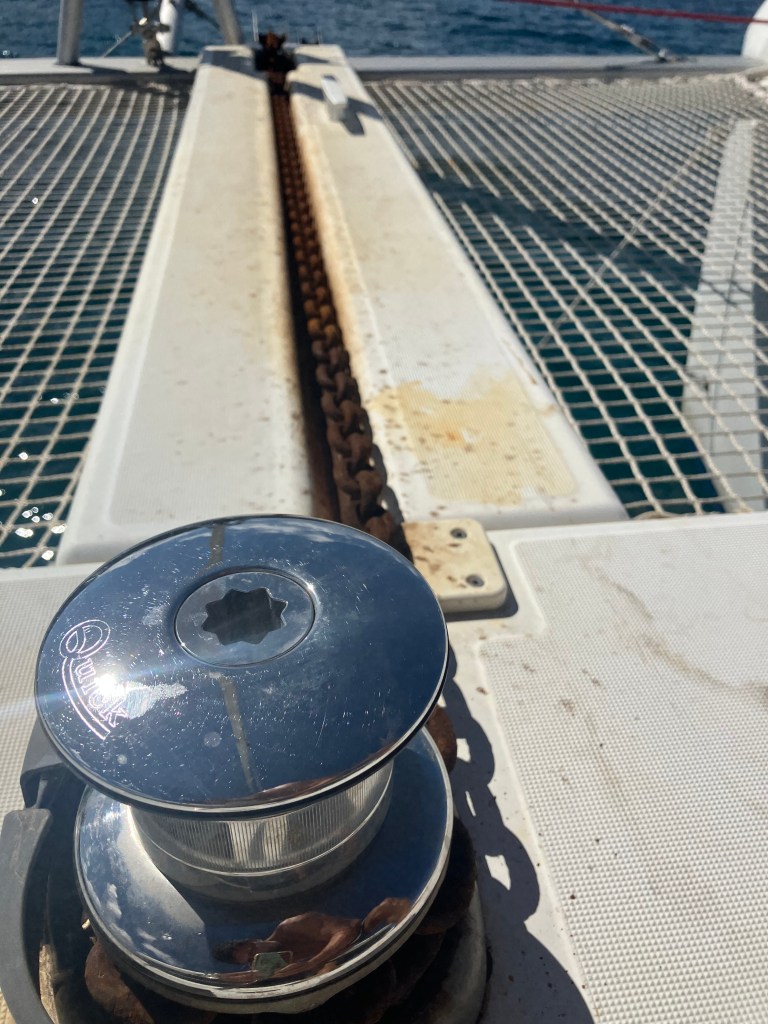
Anchoring also has the advantage of being free in most of the places we’ve been although you have to use the nautical maps, apps, internet, and rumor to figure out where anchoring is permitted and not. Only once have we been surprised by the French coast guard as they hit us with their siren and asked for our papers. We were anchored (surrounded by 8+ other anchored boats) in what had become a restricted anchorage. Luckily, they only shooed us away and issued a verb warning. At least that is what we think they said as we made flamboyant hand gestures and sailed away.
However, anchoring is the most uncertain option. The boat is vulnerable to all the boats and elements around us. We have woken up in the middle of the night to see a boat drifting toward us, as its anchor dragged through the sand. With the long amounts of chain let out, the boat can move in many more directions than it might on a mooring, and certainly more movement than when on a dock. If we leave our boat at anchor and go on a trip- we prefer to have a friend come aboard and check our systems, make sure the boat isn’t moving, make sure that the boats around us at anchor are also not causing us damage.
So, every day, we ask ourselves- what is the best option for us tonight? What is the best option for us while we visit friends on shore? We weigh the options and make the best judgement we can with the information we have, and we remain vigilant to the possibility that we might have to move the boat at a moment’s notice.
-Lindsay and Paul

 TIBURON MARINO